

A few days ago, I visited Charlotte Mensah: Community Matters, a retrospective celebrating forty years of Mensah’s work across hair, culture, entrepreneurship and community. It positioned the salon as a cultural space and Mensah’s practice within a network of Black British beauty, business, craft and community.
Walking through it made me think about curation itself. I’ve never kept it a secret that I desire to curate my own exhibition, so that was front of mind when navigating the space.
We tend to imagine the curator’s job as selecting objects, however, I think good curation is really about relationships. A curator does not merely ask, Is this interesting? They are asking, Why this? Why here? What does its presence make possible? What story emerges from bringing these particular things together?
Since then, I’ve begun thinking about people in a cultural space. The people are not incidental to the room. The people are part of the architecture.
This is why I have become increasingly interested in what feels like a crisis of cultural curation. Across apparently unrelated industries, the same question keeps surfacing: when did visibility become one of our primary qualifications for entry?
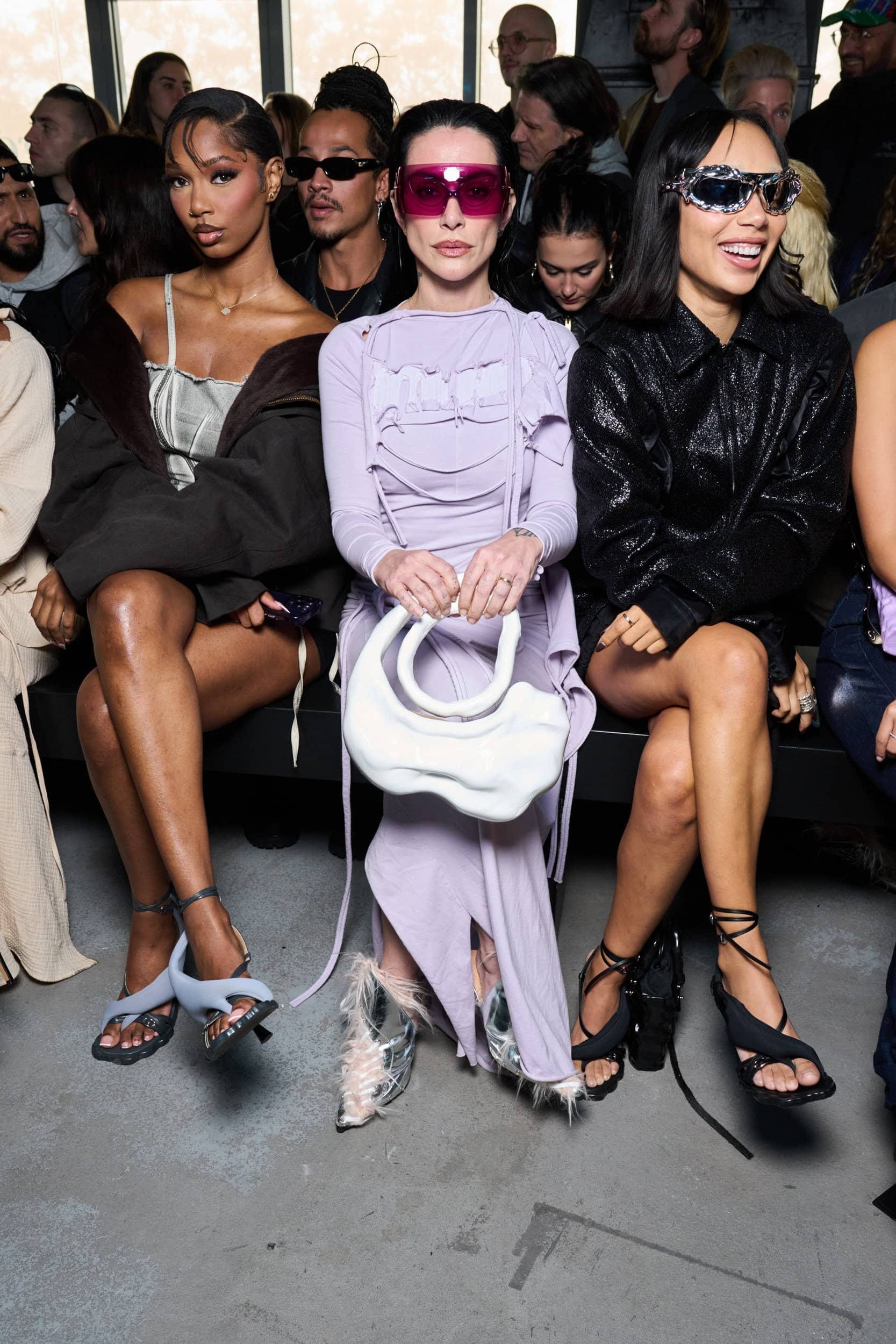
There were three posts on Instagram across different industries that presented this problem to me. I first noticed it through fashion. Model Shaun Ross recently articulated a frustration I have heard in different forms from people across the industry: fashion spaces that were once populated largely by editors, stylists, buyers, designers, journalists, photographers and other figures embedded in the industry are increasingly built around people whose most obvious qualification is an enormous online audience. The complaint is easy to dismiss as anti-influencer snobbery, but I think that misses the more interesting question. It is not simply about whether an influencer deserves to attend a fashion show. It is about what kind of room fashion is trying to create, and what happens when the logic determining that room changes from your relevance to your reach.
Then I saw almost the same debate happening in tennis. Then in publishing. Three very different industries, all arriving at variations of the same problem.

Fashion and the Changing Purpose of the Front Row
Fashion is perhaps the clearest place to begin because fashion has always understood that an audience can be curated. The traditional fashion-show guest list was never random. A fashion show existed within an ecosystem. The clothes were at the centre of the event, but the people surrounding those clothes helped determine where they travelled next.
No, this old system should absolutely not be romanticised. Fashion’s gatekeeping was deeply tied to class, race, education, geography, networks and institutional prestige. Access to the right fashion school, magazine, internship, editor, PR company or social circle could determine whether someone was even allowed close enough to demonstrate what they knew.
For Black people and many others outside fashion’s preferred social circles, possessing knowledge, talent or taste did not necessarily translate into access. So when social media destabilised this hierarchy, something important happened. A person no longer necessarily needed an editor to declare that they had taste. They could demonstrate it directly to an audience. A stylist did not need to wait for a magazine to offer them a platform. A Black creator whom traditional fashion media might never have noticed could build hundreds of thousands of followers independently and arrive at the industry’s gates already possessing cultural power.
The influencer was, in part, a revolt against established cultural gatekeeping. That matters. The ‘ordinary’ person could suddenly enter spaces that had historically signalled—sometimes subtly and sometimes quite deliberately—that they did not belong there. Social media weakened the monopoly traditional tastemakers held over deciding who deserved attention because audiences could begin appointing tastemakers of their own. There was something genuinely democratic about that shift.
The difficulty is that the mechanism which disrupted one gatekeeper has gradually become capable of becoming another. If the old question was, ‘Who do you know?’, the new one can increasingly become, ‘How many people know you?’
That is not necessarily the abolition of hierarchy. It may simply represent a change in the currency through which hierarchy operates.
What is the Influencer there to do?
This is where I think the argument needs more nuance than simply complaining that influencers are attending too many events. What function does the influencer serve? More crucially, who does that function serve?
From the perspective of a brand, institution or event organiser, the answer can be extremely rational. The influencer extends the boundaries of the room.
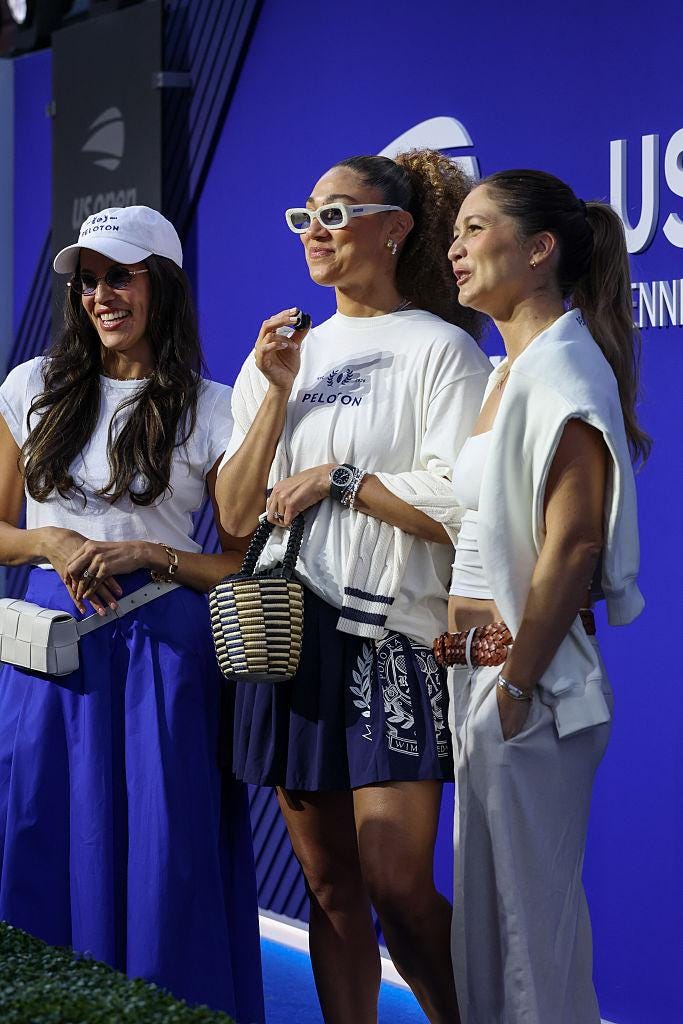
A fashion show may physically accommodate a few hundred guests, but somebody with two million followers potentially transports that experience to millions more. A creator attending the US Open can introduce tennis to people who would never read traditional sports journalism. A BookTok creator might place a novel in front of hundreds of thousands of potential readers in the time it takes a newspaper review to reach a fraction of that audience. Influencers are therefore not simply guests, they are distribution networks. They carry the room outside the room, and that can have genuine value.
A young person who has never watched tennis might see their favourite fashion creator at the US Open, become curious about the clothes, then the players, and eventually the sport. Somebody previously uninterested in a designer may encounter their collection because an influencer they follow attends the show. An author may find an entirely new readership because somebody with cultural reach talks about their book. This is where the influencer can genuinely democratise access. However, I think we need to interrogate what kind of access is being offered.
Is the audience actually being invited into the world? Or are they being invited to desire the world from outside it?
If an influencer spends Fashion Week moving between designer shows, gifted cars, five-star hotels, exclusive dinners and luxury products, how many of the people consuming that content can realistically participate in the lifestyle being presented?
If somebody attends tennis through a hospitality suite costing thousands of pounds, does their content meaningfully introduce their audience to tennis—or does it primarily introduce them to an elite experience surrounding tennis that most viewers will never be able to purchase?
If it is the latter, does that matter? Perhaps aspiration is part of the product.
The viewer may not need to believe they will ever occupy the exact seat. They simply need to want proximity to what that seat represents. Fashion. Access. Wealth. Beauty. Status. Belonging. The experience becomes desirable partly because it remains inaccessible.
The Thirst to be in the Room
This may help explain what I can only describe as the increasing thirst to be in the space. To attend because attendance itself communicates status. To be seen in the space because being seen there tells other people something about who we are.
There is obviously nothing new about status signalling. Human beings have always used clothes, possessions, clubs, restaurants, neighbourhoods and cultural affiliations to communicate social position. Thorstein Veblen was writing about conspicuous consumption in the nineteenth century. Social media has simply given that behaviour a permanent audience.
What interests me more is whether the desire to be seen inside certain spaces is beginning to outweigh the desire to experience what the spaces were created for.
bell hooks offers a useful framework here. In All About Love, hooks repeatedly connects consumer capitalism with a condition of perpetual wanting: a marketplace functions particularly well when people remain convinced that something is missing and that satisfaction may be obtained through the next purchase, acquisition or experience. She writes that keeping people in a state of ‘perpetual desire’ strengthens the marketplace.
I wonder whether the contemporary attention economy operates through a similar mechanism.
Perhaps it is no longer simply: I want that handbag.
It is: I want that life.
The object is no longer enough. Now we consume proximity.
This is why the influencer’s role is complicated. They may genuinely open the door, but they may simultaneously make the door itself more desirable. If their audience cannot afford the lifestyle being presented, aspiration can easily become FOMO: not simply admiration for somebody else’s experience but a persistent sense that life is happening elsewhere, among people with better access.
Which raises another curatorial question:
If your event reaches millions of people who can only ever experience it as something they are excluded from, what exactly have you created?
Tennis: When the Audience Becomes Part of the Tournament
The US Open makes these questions even more interesting because tennis has historically communicated exclusivity almost as efficiently as fashion.
Tennis has long carried associations with private clubs, class distinction, etiquette, wealth and social prestige. Its major tournaments are sporting events, but they are also extraordinarily coded cultural environments. Wimbledon does not feel like the US Open, and the US Open does not feel like Roland-Garros. Dress, food, architecture, sponsorship, ritual and audience behaviour contribute to the identity of each tournament.
Then tennis became fashionable again.
Fashion brands moved closer to the sport. Tennis aesthetics migrated into lifestyle culture. Celebrity attendance became increasingly visible. The stands became a fashion story. Hospitality became content.
The US Open recognised the opportunity. In 2025, it introduced a formal credential for content creators, accrediting creators beyond traditional tennis media precisely because people working in fashion, lifestyle, food, wellness and entertainment could introduce the sport to audiences traditional sports journalism might not reach.
Commercially, this makes complete sense. If somebody who follows a fashion creator because of their clothes becomes interested in Naomi Osaka because they watched that creator attend her match, tennis has gained something. The problem begins when content creation changes the relationship between audience and event.
A tennis spectator is not merely consuming entertainment. They participate in the atmosphere within which elite sport is performed. Tennis etiquette—silence during points, movement between games, respect for players—is not decorative tradition. It contributes to the conditions under which the sport takes place.
When a cultural event becomes sufficiently desirable as a backdrop, two forms of spectatorship can begin colliding. There is the person primarily there to watch tennis. Then there is the person for whom tennis is partly the context through which content about themselves is produced. Neither category is absolute. A person can love tennis and create content simultaneously. However, the distinction matters because once enough attention shifts from the thing to being seen at the thing, the atmosphere changes.
The event itself becomes increasingly secondary to the status attached to attendance.
This is how we arrive at the strange phenomenon of consuming the audience consuming the event. There is the match, then the audience watching the match. Then the social-media audience watching photographs and videos of people watching the match. This third layer sits a commercial ecosystem of brands, hospitality, celebrity and influence.
The US Open is therefore no longer monetising only tennis. It is monetising proximity to tennis.
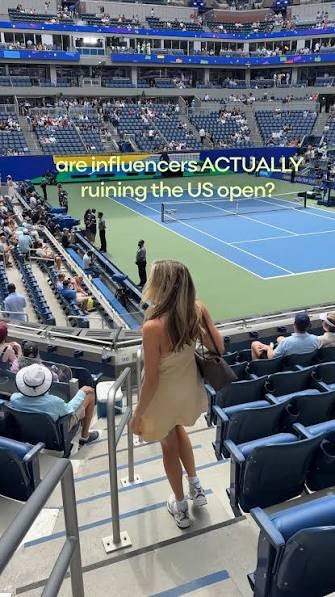
That has enormous commercial potential, but it creates a difficult balancing act. Tennis needs new audiences. It should not retreat into the exclusionary private-club mentality that historically restricted participation. Yet a tournament also has to retain enough specificity that it still feels like a tennis event rather than a luxury lifestyle activation in which tennis happens to be playing in the background.
This is why I think better curation matters. Who is invited and why? What understanding accompanies the invitation? What happens to the ordinary supporter as the cultural desirability of attendance increases prices?
The lifelong fan may pay increasingly large sums to be there. The influencer may attend for free because their visibility possesses greater commercial value. That might be logical from a marketing perspective. Culturally, however, it leaves us with an uncomfortable question:
What happens when the person who loves the thing becomes less valuable than the person who can advertise the thing?
Publishing and the Outsourcing of Risk
Publishing takes the argument somewhere more interesting because here there is no physical guest list. Publishing shares something important with fashion and tennis: it is historically elitist. Educational privilege, social networks, geography and the ability to sustain poorly paid cultural labour have long influenced who gains access. We should therefore be wary of imagining some earlier publishing industry governed purely by literary merit.
Now, social media introduces a new form of gatekeeping. Writers have increasingly been encouraged to demonstrate not merely that they possess a worthwhile idea but that they possess an existing audience for it. The language used is often “platform”. Traditionally, one of the major functions of a publisher was to identify promising work and then use institutional infrastructure - editing, distribution, publicity, marketing, media relationships and bookselling networks - to help that work find readers.
When an author’s existing audience becomes part of the assessment of whether they are worth publishing, some of that responsibility is transferred onto the writer. The writer is effectively being asked to demonstrate evidence of a market before the institution decides whether to invest in creating one.

Commercial logic explains why. Publishing is expensive. Books can fail. An author who already has hundreds of thousands of followers appears less risky than one whose name nobody knows. Writing a good book and building a successful social-media presence are fundamentally different skills. Literary writing can require solitude, patience, complexity and sustained concentration. Social platforms often reward frequency, immediacy, personality, visual fluency and constant engagement.
Some writers will excel at both, but should we expect every important writer to?
There is something somewhat bleak about imagining that a writer capable of producing important work might be considered commercially inconvenient because they have not also mastered the performance of visibility. That being said, as I’m someone who is not only a writer but also an entrepreneur, I am of the belief that we cannot depend solely on the institution to do the work for us. We have to get up and be active in going directly to our audience.
Cultural Capital Versus Attention Capital
Pierre Bourdieu’s idea of cultural capital is useful here because it describes the knowledge, tastes, codes and competencies through which people navigate cultural worlds.
Fashion has its cultural capital: collections, designers, silhouettes, fabrics, references, schools and histories. Tennis has its own: players, surfaces, rivalries, etiquette, tactics and tournaments. Publishing has genres, editors, imprints, prizes, literary histories and critical traditions.
None of this cultural capital is innocent. Historically it has often allowed privileged groups to convert access into “taste” and then present that taste as naturally superior. Now social media has introduced another extraordinarily powerful form of currency. We could call it attention capital.
Cultural capital says:
I understand this world.
Attention capital says:
I can make people look at this world.
Both have value. The historian with eight thousand followers may understand the collection more deeply than the celebrity with eight million. The celebrity may introduce that collection to people the historian could never reach. The intelligent response is not to pretend one is authentic and the other fraudulent.
It is to recognise that they perform different functions. Reach is one form of value but I don’t think it’s the sole definition of value.
That distinction is exactly what I believe curation is supposed to recognise.
Black Culture Already Knows How To Build Another Room
Black cultural history makes this conversation especially interesting because when institutions have refused us meaningful space, Black communities have repeatedly created alternative systems of value.
Notting Hill Carnival is one example. The street became cultural infrastructure: a place for Caribbean music, Mas, gathering and expression within a Britain where Black presence was often treated with hostility.
Dancehall provides another. Its communities did not wait for an elite cultural institution to decide which selectors, sounds, dancers, fashions or bodies deserved importance. They constructed their own codes, aesthetics, celebrities, spaces and hierarchies of taste.
Fashion contains equally compelling examples.
The Lo Lifes did not wait for Ralph Lauren to place young Black and Latino New Yorkers at the centre of its vision of aspirational American life. They collected, appropriated and recontextualised Polo until those clothes carried meanings that the brand had not authored.
Dapper Dan similarly transformed the codes of luxury in Harlem. When established luxury houses were not dressing Black communities in the way those communities wanted to see themselves, he repurposed their symbols through an entirely different cultural vocabulary.
These were not simply marginal consumers asking established institutions to make room for them. They were acts of cultural authorship. When the room did not accommodate them, they built another room.
Will the Disruptors Eventually Rebel Again?
Perhaps this is what comes next. How long can spaces organised increasingly around visibility continue before the people frustrated by them stop seeking admission and begin gathering elsewhere? Fashion seems particularly vulnerable to this kind of rebellion because fashion has always renewed itself from the margins.
A designer does not technically require the conventional runway. A collection can be shown in a house, warehouse, street, nightclub or gallery. Writers and critics can build independent publications. Historians can create newsletters. Designers, photographers, collectors and stylists can organise dinners, salons, exhibitions and small presentations.
If official Fashion Week becomes so saturated with generic visibility that people who genuinely care about fashion no longer recognise the culture in the room, perhaps they will simply make another room. If that room becomes interesting enough, fashion will eventually discover it. That is how fashion frequently works. The institution establishes a centre. The margin challenges it. The margin becomes culturally desirable. The institution absorbs it. Another margin appears.
This isn’t something that can be done with tennis however. You cannot simply create an alternative Wimbledon or US Open in a warehouse. Grand Slam tennis depends on players, infrastructure, rankings, broadcast rights, enormous venues and decades of accumulated prestige. You could create new clubs, alternative viewing communities and cultural spaces around the sport, but reproducing the institution itself is much harder and it is the validation from the institution that make people feel valued, and that they matter.
Publishing could sit somewhere between the two. A writer can self-publish. They can start a newsletter. Independent presses can circumvent traditional gatekeepers. Authors can increasingly reach readers directly. Yet publishing exposes another uncomfortable truth, which is that institutional validation still matters. Let’s just keep it a buck. A major publisher choosing your manuscript means something. A review in a respected newspaper means something. Being nominated for an established literary prize means something. Being invited to Fashion Week means something. Having work acquired by a museum means something.
We can intellectually critique the institution while still emotionally responding to its approval. Institutions possess infrastructure, money, distribution, archives, networks, expertise, media power and symbolic authority accumulated over decades. So perhaps people do not always want to destroy the institution. Maybe what they want is for the institution to recognise value differently.
Curate the Ecosystem, Not the Clout
I suspect the current model will eventually provoke some kind of correction because attention economies depend upon novelty. If everybody attends everything, attendance will eventually lose its cultural status. If every Fashion Week produces the same style of influencer content, audiences eventually become bored by it.
If every premium sporting event becomes a generic celebrity backdrop, the very specificity that made the event desirable starts to weaken.
And if every writer is required to behave like a creator, perhaps literature itself becomes narrower, because we begin selecting disproportionately for people willing and able to perform their lives publicly.
The irony ‘might’ be that specificity becomes the next luxury.
Perhaps the next counterculture does not reject visibility altogether. Perhaps it simply puts visibility back into proportion. Reach alongside expertise. Influence alongside contribution. New audiences alongside existing communities. Who is the room for? That is the question every institution should begin with, and curate the culture from there.
This is why I started my essay with the title of Charlotte Mensah’s exhibition: Community Matters, because community is not created simply by assembling large numbers of people in one place, nor by generating millions of impressions around them. Community requires relationships, shared knowledge, participation, memory, exchange and care.
Black cultural history has already shown us what can happen when existing institutions refuse to create meaningful space. We create one. The challenge now is to build those spaces without reproducing the hierarchies we were trying to escape, while simultaneously demanding that established institutions become sophisticated enough to recognise forms of value that cannot be reduced to follower count.
We need spaces capable of recognising many different kinds of cultural value. We need curators—whether they call themselves curators, editors, publishers, PR directors, brand managers or event organisers—willing to make those distinctions deliberately.
One day an institution may look around its beautifully photographed, highly visible, commercially successful room and discover that somewhere along the way it succeeded in building an enormous audience, but lost the community.
Those are not the same thing.
You really spoke something in me in this article. A lot of visibility or attention craving is happening at the moment and especially like you said in the fashion industry. It is definitely an oversaturated space but yes everything goes hand in hand and curating new fashion communities might help push fashion into a more authentic light.
Hi @Fashion Culture History I’d love to connect, sending you through a DM about an article I’m writing. NSJ